Every business has a sales funnel, whether it is written down or not. People find you, get in touch, become clients and, ideally, come back and refer others. In most businesses each of those stages depends on someone remembering to do the next thing: reply to the enquiry, send the follow-up, chase the quote, ask for the review.
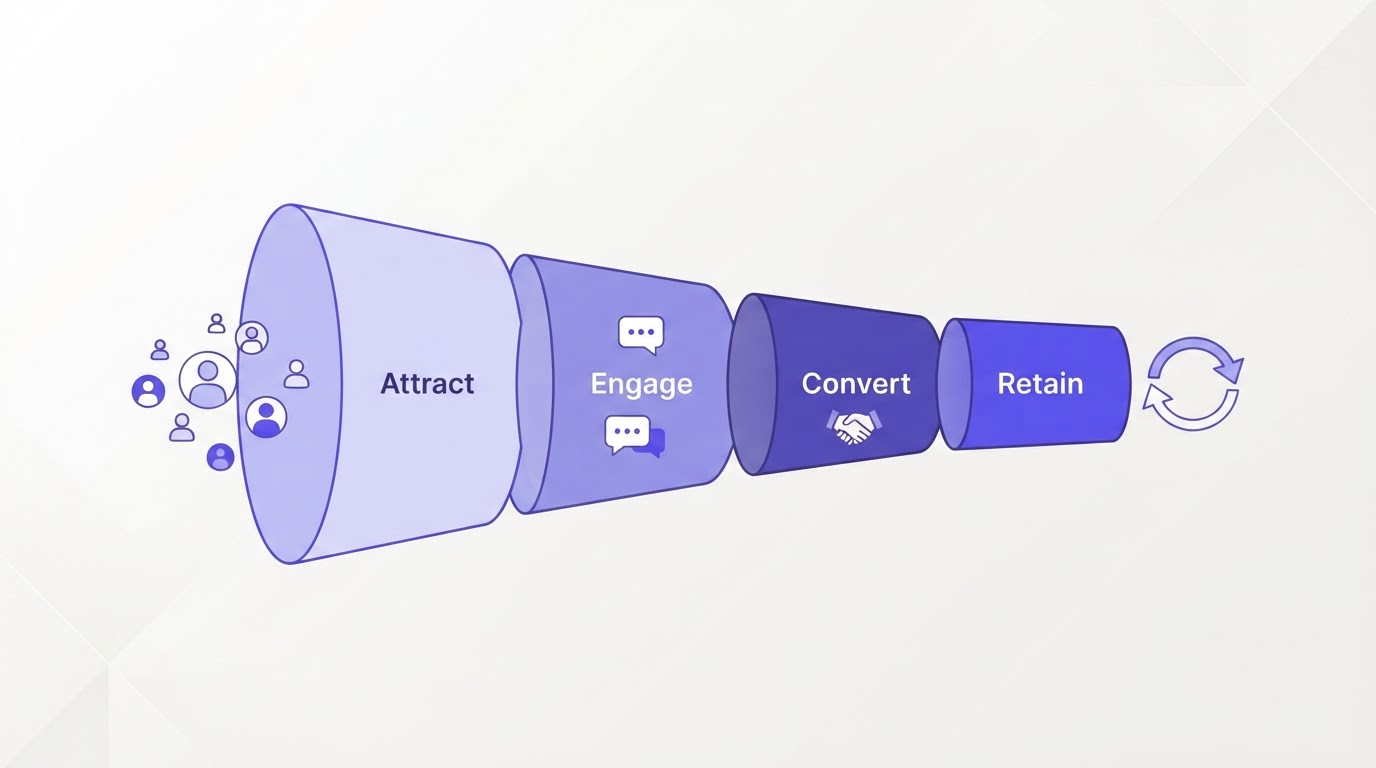
Sales funnel automation makes sure those next steps happen on time, every time. In this article we walk through the four stages of the funnel, attract, engage, convert and retain, with concrete automations for each one, and explain how we set this up for clients.
What sales funnel automation is
Sales funnel automation means using software to carry out the routine steps between a first contact and a closed deal, and beyond. Plain automation handles the timing and the routine: replies, reminders, follow-ups and updates. AI adds value where judgement on text is needed: qualifying a lead from a message, drafting a personalised reply or summarising a conversation for your team.
The goal is not to remove people from Sales. It is to make sure no lead waits, no follow-up is forgotten and your team spends its time on the conversations that need them.
Stage 1: Attract
The attract stage is about capturing every lead, from every channel, in one place.
- Lead capture from every source: website forms, chat, social media, portals and calls flow into one CRM automatically, tagged with their source, so nothing sits in a separate inbox.
- AI chat on your website: a chat assistant answers common questions at any time of day and asks for contact details when a visitor shows interest.
- Consistent content: content is prepared and scheduled across your channels, so you stay visible without someone posting manually every day.
Stage 2: Engage
The engage stage is about responding quickly and staying in touch until the lead is ready.
- Instant first response: every new lead receives a personal reply within minutes by email, text or WhatsApp, with a link to book a call.
- Lead qualification: AI reads the enquiry and asks a few short questions to understand fit and timing, then scores the lead and routes it to the right person.
- Nurture sequences: leads that are not ready yet receive useful, relevant messages over weeks or months, and the sequence stops as soon as they reply or book.
Stage 3: Convert
The convert stage is about turning interest into a signed deal without delays.
- Appointment booking: leads book directly in your calendar and receive confirmations and reminders, so fewer meetings are missed.
- Pre-meeting briefing: before each call, your team receives a short summary of the lead’s history, questions and score.
- Quotes and follow-up: quotes are prepared from the information gathered, reviewed by your team and sent, with an automatic follow-up if there is no reply.
Stage 4: Retain
The retain stage is about turning a client into a returning client and a source of referrals.
- Onboarding: new clients receive a structured welcome, the information they need and the next steps, without your team sending it by hand.
- Review and referral requests: at the right moment, satisfied clients are asked for a review or a referral, with a reminder if needed.
- Check-ins and renewals: clients receive timely check-ins, renewal reminders and relevant offers based on what they bought before.
How we set it up
We do not start with tools. We start by mapping how leads move through your business today, from the first contact to repeat business, and where they slow down or drop out. That shows which stage of the funnel needs attention first.
We then build the funnel in CloudQonnect, which brings lead capture, CRM, messaging, booking, pipelines and reporting together in one platform. Where a process needs more, such as reading documents, preparing quotes or connecting to other systems, we add workflows in n8n. Every automation is tested with real leads and reviewed with your team before it runs on its own.
Read more about what we automate in Sales and Marketing on our Automations page.
Measuring your funnel
Automation makes your funnel measurable. Track a few numbers per stage:
- Attract: leads per source
- Engage: time to first response, share of leads qualified
- Convert: meetings booked, quotes sent, deals won
- Retain: reviews received, repeat clients, referrals
Look at where the biggest drop sits between two stages. That is usually where the next automation pays off most.
Where to start
If you want to know which stage of your funnel loses the most leads, our free audit maps how leads are handled today and what to automate first.
Frequently asked questions