Every enquiry looks the same when it lands in the inbox. A name, an email address, sometimes a phone number and a short message. Behind those enquiries sit very different people: a buyer who wants a viewing this week, someone who is just browsing, and someone who will be ready in six months. The job of lead qualification is to tell them apart, quickly, so your team spends its time on the conversations that matter.
AI lead qualification does that work automatically. In this article we explain how it works, how it differs from traditional lead scoring, and how an estate agency can use it to respond to every enquiry and still focus on the buyers who are ready to talk.
Why speed and focus matter
Speed is the first reason. Research published in Harvard Business Review found that companies that contacted a lead within an hour were nearly seven times as likely to qualify that lead as companies that waited even one hour longer, and more than sixty times as likely as companies that waited 24 hours or more.
Focus is the second. When every lead is treated the same, your team either chases everyone and burns time on enquiries that were never going to buy, or chases the ones that look promising at first glance and misses the rest. Neither scales.
What AI lead qualification is
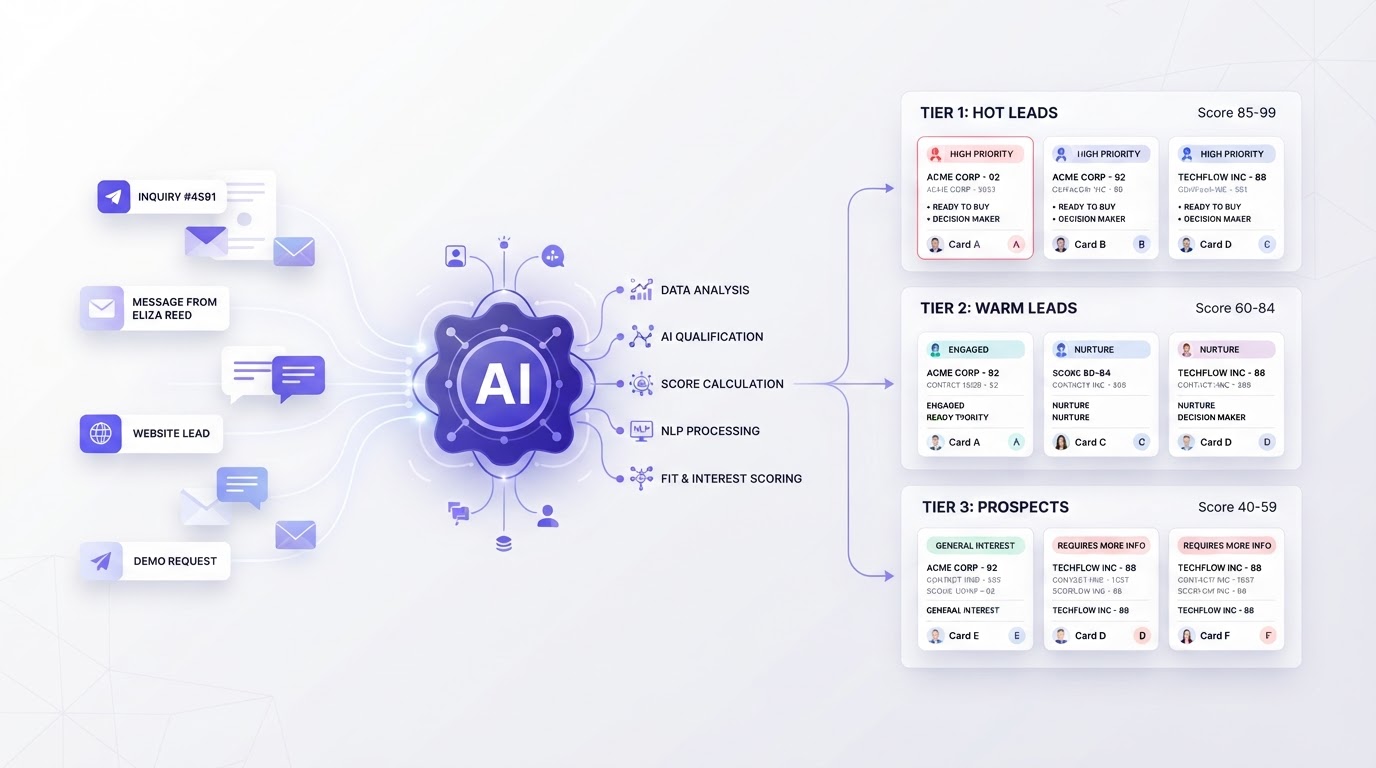
Lead qualification answers two questions about every enquiry: does this person fit what we offer, and how ready are they to act? AI lead qualification answers both automatically, using the information you already have plus the information the lead gives when asked.
It usually combines three types of signal:
- Fit: does the lead match your offer? Think budget, location, property type, company size or service needed.
- Intent: what is the lead trying to do? A viewing request, a question about availability or a request for a quote all signal more intent than a general question.
- Engagement: how does the lead behave over time? Repeat visits, opened emails and replies to follow-up messages all add up.
AI lead qualification vs traditional lead scoring
Traditional lead scoring works with points: ten points for a form fill, five for an email opened, twenty for a demo request. It is simple and predictable, and for many businesses it is a good start. Its weakness is that the rules are set once and rarely updated, and that it cannot read what people actually write.
AI adds two things. It can read free text, so a message such as “we have sold our house and need something before September” is recognised as a strong buying signal. It can also ask questions, through an AI agent on your website, by email or on WhatsApp, and use the answers to complete the picture.
| Traditional lead scoring | AI lead qualification | |
|---|---|---|
| How it scores | Fixed points per action | Fit, intent and engagement combined |
| Free text | Ignored | Read and understood |
| Missing information | Stays missing | Asked for by an AI agent |
| Updates | Manual, when someone remembers | Rules and prompts adjusted as you learn |
| Explaining a score | Easy | Needs a short summary per lead |
The best setups use both. Simple rules handle the obvious cases; AI handles the messages and conversations that rules cannot read.
Example: AI agents for real estate lead qualification
Estate agencies are a clear case. Enquiries arrive from property portals, the website and social media, often in the evening and at weekends, and a large share of them come from people who are not yet ready to buy or sell. This is how our Lead-to-Close System handles a typical evening enquiry.
- 1.An enquiry comes in at 21:00 through a property portal about a three-bedroom house.
- 2.Within a minute, an AI agent replies by email or WhatsApp, thanks the person and asks a few short questions: are they looking to buy or rent, what is their timeframe, do they already have a mortgage in principle, and do they have a property to sell?
- 3.The answers are saved in the CRM, and the lead is scored on fit (budget, area, property type) and readiness (timeframe, mortgage, chain).
- 4.A ready buyer is offered viewing slots straight away, and the agent receives a notification with a short summary of the conversation.
- 5.A buyer who is interested but not ready receives matching listings and a check-in at the moment they said they would be ready.
- 6.A seller who mentioned their own property is flagged for a valuation call.
- 7.The next morning, the team sees a sorted list instead of a full inbox, with every conversation and score visible in the CRM.
Nothing in this flow replaces the agent. It makes sure every enquiry gets a fast, personal answer, and that the agent’s time goes to the people who are ready to move.
How to set up AI lead qualification
- 1.Define what a qualified lead means for you. Write down the fit criteria and the signals that tell you someone is ready.
- 2.Look at your won and lost deals from the past year. Which questions would have told you earlier who would buy?
- 3.Choose where the conversation happens: website chat, email, WhatsApp or all three.
- 4.Connect it to your CRM, so every answer and score is stored with the contact, not in a separate tool.
- 5.Agree what happens per score: who gets notified, which leads get viewing slots, which go into a nurture sequence.
- 6.Start with a review period in which your team checks the scores and summaries, and adjust the questions and rules based on what they correct.
What to watch out for
- Over-automating the conversation: an AI agent should qualify and book, not negotiate. Hand over to a person as soon as the conversation needs judgement.
- Scores nobody understands: every score should come with a short summary of why, so your team trusts it and can overrule it.
- Data protection: tell people they are talking to a digital assistant, only ask for the information you need, and make sure your setup is GDPR compliant.
- Forgetting the cold leads: a lead that is not ready today may be your best buyer in six months. Keep them in a nurture sequence instead of discarding them.
Where to start
If you want to know where leads are slipping through in your business today, our free audit maps how enquiries are handled now and which steps are worth automating first.
Source: Oldroyd, McElheran and Elkington, ‘The Short Life of Online Sales Leads’, Harvard Business Review, March 2011. Link
Frequently asked questions